Showing posts with label Looney Tunes. Show all posts

Friday, February 6, 2015

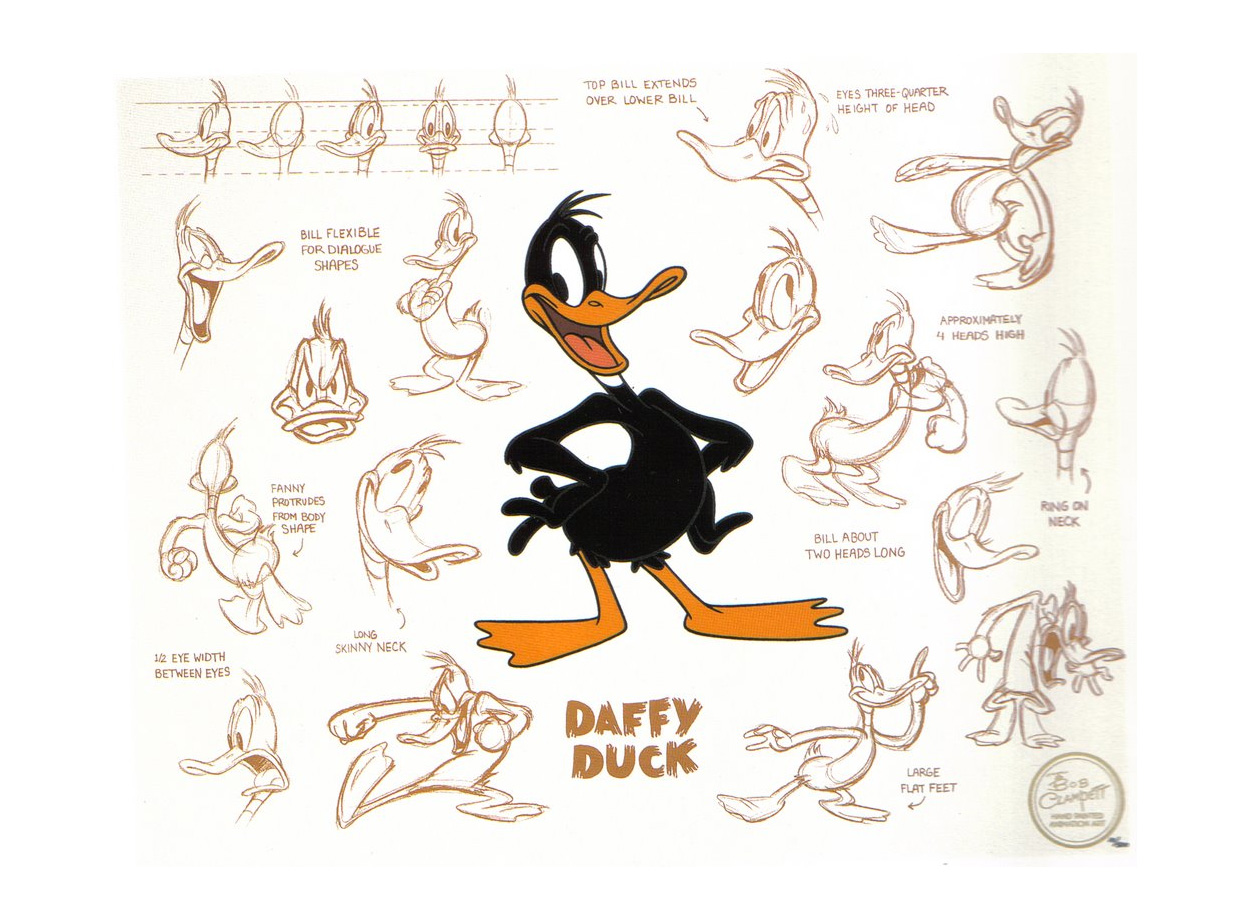
A Duck for the Ages: A Tribute to Daffy Duck


Note: This post is a response to the guys over at Trope & Dagger who are debating over the best Looney Tunes character  You should head over and check out some of their stuff if you like some differing points of view on all things pop culture.

No other cartoon series has brought us as diverse a cast of characters as Looney Tunes and Merrie Melodies, but who amongst this group can be crowned the best? It is certainly a subjective matter, but some characters do stand out more than others. My vote for Best Looney Tunes Character: Daffy Duck.

Of the dozens of characters that were created by the animators at Termite Terrace, Daffy has had the longest, most diverse career, and best represents the spirit of that ragtag collective.

Let's go back to his origins. Daffy was not the first major star at WB (that distinction belongs to Porky Pig), but unlike his stuttering costar, this duck was something new and gave birth to what would be known as the screwball character in cartoons. Bob Clampett, who along with Tex Avery created Daffy in 1937's Porky's Duck Hunt, described the phenomenon thusly:

"At that time, audiences weren't accustomed to seeing a cartoon character do these things. And so, when it hit the theaters it was an explosion. People would leave the theaters talking about this daffy duck."


Over the next thirty years Daffy would be utilized by every directorial unit at the studio, with each one lending its own flavour to the character.

Tex Avery played the duck as a ball of unrestrained manic energy, bewildering Porky, his long suffering straight man for decades.

Under Bob Clampett's unit he achieved his acme (see what I did there) as a complete lunatic who defied every law imaginable, especially the laws of physics. Animator Rod Scribner's artwork still stands as some of the wildest and funniest ever put to paper. Baby Bottleneck and The Great Piggy Bank Robbery are two outstanding examples of the looniest Looney Tune in action.


By the mid '40s, the studio had lost Avery and Clampett and cartoons were drawn by three different units. Each had their own set of characters. Friz Freling had Sylvester and Tweety and Yosemite Sam, Bob McKimson had Foghorn Leghorn and the Tazmanian Devil, and Chuck Jones had Roadrunner, Wile E. Coyote and Pepe LePew. Big stars like Bugs Bunny and Daffy Duck were shared by all three.

Of these three units, Chuck Jones emerged as the dominant creative voice and the other two directors largely followed suit in terms of types of gags and general story structure. It must be said however that McKimson held out for a few years and as a result his cartoons have a much more slapstick feel than Jones's more cerebral approach to animating.

In Jones's cartoons, Daffy's character is given a complete overhaul. Instead of a screwball, he is greedy, self-centered and conniving. He was often paired with Bugs Bunny where he served as a foil for Bugs's cool and collected demeanor. The bunny's popularity had by this time eclipsed Daffy's, and cartoons often played up this jealousy with Bugs always getting the better of his feathered costar. The Hunters Trilogy of "Rabbit Fire", "Rabbit Seasoning", and "Duck! Rabbit! Duck!" are the best examples of this.


Daffy was also successful as a headliner during the '50s and early '60s. He played Robin Hood, Duck Dodgers of the 24th 1/2 Century, and the swashbuckling Scarlet Pumpernickel. It was also during this time that he starred in "Duck Amok", regarded as one one of the greatest animated shorts ever made for it's existential breaking of the fourth wall. By the time the studio shut down in the '60s, Daffy was even playing the villain opposite Speedy Gonzalez, although these cartoons are a far cry from the duck's heyday.

Daffy Duck's career at WB spanned three decades, and Mel Blanc voiced him for 52 years, longer than any other character in the history of the medium. He's played heroes, villains, and sidekicks in settings from all times and places. He's hit Adolph Hitler on the head with a mallet! He may lack the coolness of Bugs Bunny or the tenacity of Wile E. Coyote, but he makes up for it with sheer chutzpah. Early on in his career, Tex Avery was quoted as saying, "In a cartoon, you can do anything." No character before or since has embodied that spirit as much as Daffy Duck.

Again, Daffy smacking Hitler with a mallet.

As a final note, enjoy this 13 1/2 minute supercut of all of a Daffy's loony laughter. I can't think of a better way to celebrate not just the greatest Looney Tunes character, but one of the best cartoon characters ever.


Wednesday, September 3, 2014

Why a Looney Tunes Movie Can't Work


In further news of classic cartoon properties being developed into flashy motion pictures, film sites are reporting that there is another Looney Tunes movie in the works to be written by X-Men: First Class writers Ashley Miller and Zack Stentz with Steve Carell supposedly attached to star. Details about the film, ostensibly titled Acme, are sparse, but it is hinted that it will be a "spin-off" film and will not focus on the main roster of Warner Bros. cartoon characters. It is presumed however that they will make an appearance.

Acme is just the latest movie to feature Bugs Bunny, Daffy Duck, and the rest of the Looney Tunes roster. Who can forget the stinking pile of nostalgia that is Space Jam and who can actually remember Looney Tunes: Back in Action? Neither of these movies succeeded in capturing the true essence and magic of these characters for various reasons.

Aside from perhaps the complete lobotomy that Disney gave to Mickey Mouse fifty years ago, no animated character has been as cruelly subjected to the world of pop marketing like Bugs and the gang. You couldn't walk ten feet in the '90s without seeing someone wearing a shirt with the Tasmanian Devil or a smug looking Bugs Bunny or Wile E. Coyote.


Never forget.

What many people see as the Looney Tunes brand is just a derivation of the cartoon shorts directed by Chuck Jones and Isadore "Friz" Freling in the later (and frankly lackluster) period of the Warner Bros. studio in the late fifties and sixties. They hung on longer than the other unit directors, and as the last men standing, they got to literally write the book on Looney Tunes. Since then, that one vision has been watered down and distorted into one-dimensional versions of what were originally some of the most vibrant personalities ever animated.

Case in point:  when he was created by Tex Avery, Daffy Duck was the epitome of the screwball character. Under the direction of Bob Clampett in the '40s, the character reached his peak as an unrestrained id, causing chaos for its own sake and hooting maniacally the entire time. Under Chuck Jones however, the character was changed to be the greedy, jealous asshole that most people know today. It's a cheapening of the character and central to why Looney Tunes movies don't work.

The sad matter of fact is that the Looney Tunes have lost their looney-ness. Today we have The Looney Tunes Show on Cartoon Network that is essentially Seinfeld but with talking animals. And even though that particular program has been recently discontinued, CN is quick to come back with Wabbit, a series that sounds like it will focus primarily on Bugs Bunny and will feature some new original characters. While these shows pale in comparison to the original shorts, I do appreciate that they did not try to replicate them exactly.

The original theatrical shorts were lightning in a bottle. They were created by some of the finest animators to ever pick up a pencil, and given the freedom to express themselves in unprecedented ways. The screen was barely able to contain the sheer amount of energy that was in a scant seven minutes. This highlights the other problem with movies:  they're too long for that kind of sustained action. A feature-length Looney Tunes short would be exhausting to watch. It would be like trying to eat a bowl full of candy. Sure it sounds fun, but once you dive in you (and your pancreas) start to see the error of your ways.

This does not mean all hope is lost.  In the past few years, there have been some incredible shorts that combine old sound recordings of Mel Blanc's voice and Carl Stalling's music with modern CGI tools, and the results are astounding.  Here's one from 2013 that does Sylvester and Tweety more justice than Friz Freling ever did:


The resources are out there, it's just a matter of harnessing them properly.  We shouldn't take Bugs, Daffy and the rest and put them on the shelf to gather dust and enjoy as museum pieces. These characters by their very nature are meant to be enjoyed.  Reinvention is all part of the game, but not at the expense of what made them appealing in the first place.  In short, keep the shorts short.

Tuesday, September 18, 2012

Two Big Milestones for Two Big Names in Animation

This week I'm giving a special two-for-one post.  Two big names in animation and voice acting:  one a current leader in prime time animation entertainment, and the other a legend that I almost feel bad including with the former.


First off is Seth MacFarlane's role as host on Saturday Night Live last weekend for their season opener.  It's neat in terms of animation landmarks because it was the first time that an animator has hosted the show.  I can't really imagine Walt Disney or Matt Groening doing such a thing, and I list those two because they are probably the only other animation producers that most people can name.  This really is a testament to the level of celebrity that MacFarlane has generated for himself.  Granted, I am not his biggest fan.  Family Guy has disappeared up its own rear end to become one giant meta joke and The Cleveland Show still struggles along, but  America Dad  continues to stay strong (and structured! *gasp*) and Ted  was surprisingly funny  with all of its crude jokes and Flash Gordon references.  I also am not thrilled that the shoddy animation and often lazy writing has become the face of modern animation.  Ralph Bakshi has more talent in his beard hair as far as I'm concerned, but regardless, the man has done an excellent job branding himself in a way that few animators do.

As for SNL itself, it was enjoyable enough.  Both the host and the show are loved for their quick pace, copious pop culture references, and questionable material that is sure to turn off some viewers.  In this way MacFarlane is an ideal host, although I did feel like his vocal range was not maximized to its fullest potential (barring his enjoyable, if self-promoting, opening monologue).  It was also nice to see him in a role where he wasn't calling all of the shots.  I'm sure the appearance will do plenty to build enthusiasm for the season premiere of all of his shows.


Secondly, today is June Foray's 95th birthday.  The First Lady of Voice Acting has provided some of the most memorable characters in animation history.  Her list of credits is far too long to include here, including virtually every major cartoon studio since the 40's, but some of my favorites include Witch Hazel from various Looney Tunes shorts, the Talky Tina doll from an episode of The Twilight Zone, and Natasha Fatale and Rocket J. "Rocky" Squirrel on The Rocky and Bullwinkle Show.  In a career that has spanned more than six decades and still shows no signs of stopping, she has shown a passion for animation that is truly admirable.

The range and strength of her voice have led many to call her the female Mel Blanc, but as Chuck Jones once supposedly said, "June Foray is not the female Mel Blanc, Mel Blanc is the male June Foray."  Earlier this year, Foray was finally formally recognized when she was nominated and won her first Emmy award.  Even though it was for a role on The Garfield Show, for lifelong fans, it served as a thank you for all of the years of wonderful characters and unforgettable voices.  She is a truly remarkable person and I wish her the best of birthdays!